Introducing DAX-1
By Decide Research Team
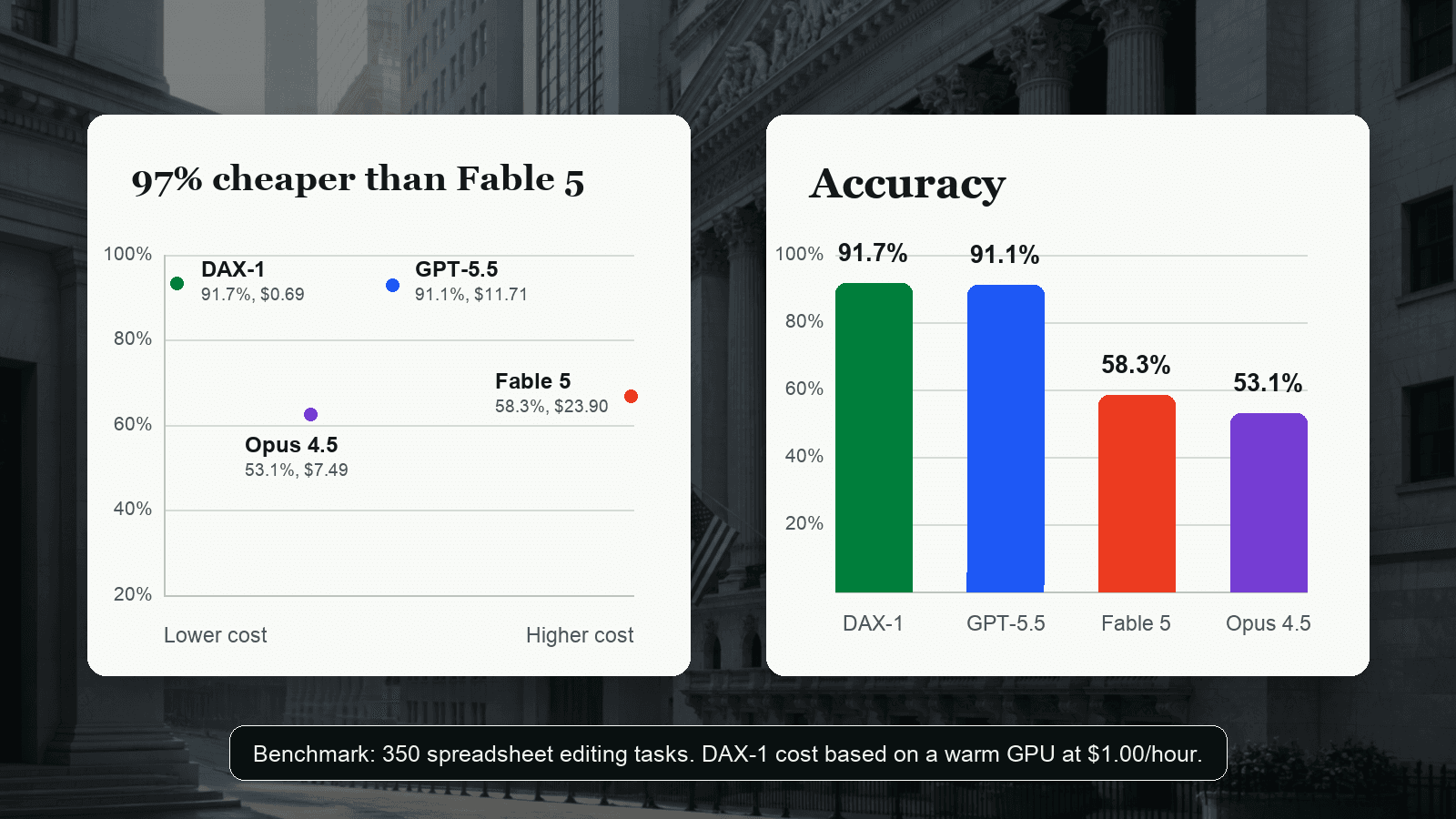
Today, we are releasing DAX-1, our flagship model for spreadsheet editing.
DAX-1 is built for the recurring spreadsheet work businesses and professionals do every day, from fixing formulas and cleaning data to repairing tables, completing lookups, and generating reliable workbook updates. On our benchmark, DAX-1 solved 321 of 350 spreadsheet editing tasks, reaching 91.7% accuracy compared with 58.3% for Fable 5. It was also 97% cheaper to run than Fable 5 and over 5x faster.
Decide already serves thousands of professionals and a growing number of API customers using our tools for spreadsheet automation and analysis. Our goal is to make spreadsheet automation and analysis more accurate, faster, and significantly cheaper to execute at scale.
The surface is enormous. Nearly 1 billion people use Excel, and businesses everywhere rely on spreadsheets to run finance, operations, reporting, supply chains, sales, and countless internal workflows.
As more of this work becomes automated, the economics of the underlying models start to matter. Repetitive spreadsheet operations happen at high volume, and using large general-purpose models for every edit can quickly become too expensive, too slow, and unnecessarily complex.
We think spreadsheet operations deserve a model built around the economics of the work itself.
That is why we built DAX-1 specifically for recurring spreadsheet editing, with accuracy, cost, and latency as the main focus.
Why spreadsheet editing?
A large part of spreadsheet work is editing.
When an analyst builds a financial model, an operations team updates a weekly report, a supply chain business reconciles inflows and outflows, or a consultant cleans client data, much of the work eventually comes down to changing the right parts of a spreadsheet while preserving everything else.
| Spreadsheet operation | Intended result |
|---|---|
| Fix a formula | Restore the correct calculation |
| Complete a lookup | Fill a missing lookup result |
| Remove duplicate rows | Keep one correct record |
| Clean up formatting | Standardize inconsistent cells |
| Delete the wrong records | Remove rows that do not belong |
| Sort a table correctly | Restore the intended order |
| Update an aggregation | Recalculate a summary cell |
These operations happen across finance, reporting, reconciliation, sales operations, procurement, supply chains, analytics, and many other business workflows.
That is why we chose spreadsheet editing as the first area for DAX-1. If businesses are going to automate more of this work, it does not make economic sense for every small operation to require a large general-purpose model.
DAX-1 focuses on deterministic spreadsheet editing. It is still an AI model, but its output is designed as a precise change that software can apply, inspect, and verify.
Instead of simply saying:
Update the formula in cell G20.
DAX-1 can return an executable operation:
{
  "patch_version": "spreadsheet_edit_patch_v1",
  "operations": [
    {
      "type": "set_cell",
      "sheet": "Model",
      "cell": "G20",
      "value": "=E20+F20",
      "number_format": "$#,##0.00"
    }
  ]
}
The JSON itself is not the important part. The contract is: identify what needs to change, make the exact change, preserve unrelated content, and verify the resulting workbook. For spreadsheet automation, sounding correct is not enough. The spreadsheet has to be correct.
How We Built DAX-1
DAX-1 is post-trained on the Qwen3-14B base model rather than trained from scratch. We specialized it for spreadsheet editing using broken workbook states, natural-language editing instructions, and corresponding repaired workbook states. Each training example teaches the model to inspect workbook context, identify the cells that need to change, and produce a minimal executable patch instead of a paragraph of advice.
The training data covers recurring spreadsheet repair tasks such as formula repair, lookup and join completion, duplicate cleanup, formatting cleanup, row cleanup, date/filter/sort repair, and aggregation repair. We serialize spreadsheet context into JSONL records, including sheet names, ranges, cell values, formulas, number formats, and the user instruction. The target output is a spreadsheet_edit_patch_v1 object that can be applied to the workbook and checked against the repaired state.
For serving, we optimized DAX-1 for lower latency and lower cost. The production model uses a quantized artifact that is much smaller than the original full-precision checkpoint, while retaining the behavior needed for our benchmark. DAX-1 is served as a specialized spreadsheet-editing sub-agent inside Decide, so supported spreadsheet edits can be routed to it directly instead of always using a larger general-purpose model. This is what allows us to improve price-performance while keeping the workflow executable and verifiable.
What DAX-1 can do
DAX-1 was trained around seven common spreadsheet-editing areas.
| Task | DAX-1 result |
|---|---|
| Formula repair | 50/50 |
| Formatting cleanup | 50/50 |
| Duplicate removal | 50/50 |
| Row deletion cleanup | 49/50 |
| Aggregation and classification | 42/50 |
| Date, filter, and sort repair | 40/50 |
| Lookup and join completion | 40/50 |
| Overall | 321/350 |
DAX-1 performs particularly well today on formula repair, formatting cleanup, duplicate removal, and row cleanup.
Lookup and join completion, along with date, filter, and sort operations, remain harder areas and are part of what we are continuing to improve.
Our benchmark is based on the resulting workbook, not whether the model produced an answer that looked plausible. A task only passes when the edit applies correctly and the final spreadsheet matches the expected state. Our public benchmark result is 321 successful tasks out of 350, or 91.7%.
DAX-1 solved 321 of 350 spreadsheet editing tasks
On the same benchmark:
| Model | Accuracy |
|---|---|
| DAX-1 | 91.7% |
| GPT-5.5 | 91.1% |
| Fable 5 | 58.3% |
| Opus 4.5 | 53.1% |
DAX-1 achieved the highest score on the benchmark, solving 321 of 350 tasks. That is 91.7% accuracy, slightly ahead of GPT-5.5 and significantly ahead of Fable 5 and Opus 4.5.
DAX-1 was strongest on formula repair, formatting cleanup, duplicate removal, and row cleanup, while lookup, join, filtering, and sorting tasks remain areas we are continuing to improve.
97% cheaper than Fable 5
On our benchmark:
| Model | Benchmark cost | Cost per verified pass |
|---|---|---|
| DAX-1 | $0.69 | $0.0021 |
| GPT-5.5 | $11.71 | $0.0367 |
| Opus 4.5 | $7.49 | $0.0403 |
| Fable 5 | $23.90 | $0.1172 |
DAX-1 costs about 97% less to run than Fable 5 on this benchmark.
Another way to look at it is the cost of getting a correct result. DAX-1 costs about $0.0021 per verified pass compared with $0.1172 for Fable 5, a 98.2% reduction in cost.
At 1,000 successful spreadsheet edits, that is roughly $2.10 with DAX-1 compared with $117.20 with Fable 5.
For thousands or millions of recurring operations, that difference changes what becomes economically practical to automate.
5x faster than Fable 5
The third area we focused on was latency.
In our serving tests, DAX-1 recorded a median response time of 1.48 seconds, compared with 2.64 seconds for Opus 4.5, 7.71 seconds for Fable 5, and 7.84 seconds for GPT-5.5.
At the slower end of requests, DAX-1 recorded a p95 latency of 2.42 seconds, compared with 6.54 seconds for Opus 4.5, 15.85 seconds for Fable 5, and 20.50 seconds for GPT-5.5.
For a user working inside Excel or Google Sheets, this matters.
For an API processing spreadsheet operations at scale, it matters even more.
Routine edits should feel routine.
What DAX-1 means for Decide
DAX-1 is part of our broader mission at Decide to become critical infrastructure for spreadsheet operations on the internet. We are already working toward this through Decide on the web, our Excel and Google Sheets plugins, API, and Decide for Work.
We are integrating DAX-1 as a sub-agent across Decide on the web, our Excel plugin, Google Sheets plugin, and API. For supported spreadsheet-editing tasks, this lets us route work to a model built specifically for the job, improving speed, cost, and reliability.
DAX-1 also represents a strategic shift in how we operate as an applied AI lab. We are approaching more problems from first principles, including post-training our own models for the workloads we care about, instead of relying entirely on frontier models to solve every problem.
If Decide is going to become critical infrastructure for spreadsheet operations on the internet, we need more control over the performance and economics of the underlying stack. DAX-1 is an important step in that direction.
Availability
DAX-1 is currently powering our agents across Decide on the Web, Excel, Google Sheets, and our API.
We are also releasing DAX-1 as an open-weight model for research use on Hugging Face, alongside the DAX-1 Technical Report with a detailed look at how we built, trained, evaluated, and serve the model.